Pages

Showing posts with label Church. Show all posts

December 28, 2009

Sola Scriptura?


Last night I was talking to some friends of mine who happen to be Catholic. And not just casually catholic, attending mass and holding on to the faith of their parents, but Catholic in the best way, having converted to the faith later in life after studying and reading and discussing what the Catholic branch of Christianity has to offer, and studying hard at schools like oxford and UCLA.
And the discussion of infant baptism came up. Now I go to a Protestant where, although I have never seen nor heard of anyone in our denomination practice infant baptism, it is technically on the books as a good and right practice. However with some understanding of how it is practiced in the Catholic church this form of infant baptism is completely different from what they practice. From reading the liturgy associated with infant baptism in my church it is easily seen that it really is a dedication by the parents to raise their children in accordance with Christian beliefs; its a symbol that doesn’t mean anything but allows those arround them to help keep them in accountability.
The Catholic church on the other hand, sees baptism as the means that God uses to cleanse us of original sin. And though they get the general belief that baptism is important to the believer and commanded by God, the specifics of why they get baptized comes from another source- tradition. From the earliest of Christian writers, we can see that baptism was practiced to remove sin from the believer.
It wasn’t the topic of infant baptism that had me intrigued, rather it was the negation of that most important component of truth that is held by most protestant churches- Sola Scriptura, Scripture Alone. Ask any protestant believer what they teach at their church, and the responses will be similar, well we just teach the bible. Which in itself is interesting because if all churches were to “just teach the bible” there would be no denominational distinctives, and therefor no reasons for denominations to exist. If we were honest with ourselves we would probably say that our church teaches our pastor’s view on the bible (hopefully informed by the holy Spirit). But even that isn’t entirely true either because most pastors, after choosing their passage for the week, read various sermons and commentaries on what other people who had more time or knowledge have said about scripture. So a Sunday morning sermon must be in part though to be a third party’s, often of unknown origins, ideas about the bible.
Now some might take that as a disrespect to the office of pastor, but the role of a pastor is primarily in communication of truth and personal ministry, and not as theologians proper but it does raise an important question- who does you pastor turn to for truth? Which theologians, historians, and church fathers are informing their understanding, and how is that informing yours? We say “Only Scripture” or “Just the bible” but even our most basic ideas about who God is, are informed by Scripture and Tradition.
Go to your favorite bible word search site (I like blueletterbible.org) Now type in the word “Trinity” Go on, I will wait for you. Nothing? Lets try “Rapture”. Still nothing? Neither of these ideas is strictly from scripture though people support the ideas of each of these from scripture (The concept of the trinity has been around for 2000 years, and rapture for only about the last 150, which accounts for my reluctance to support the idea of a rapture of the church, but that is for another time) The point is, our understanding of who God is, the very core of our Christian faith, is defined in part by tradition.
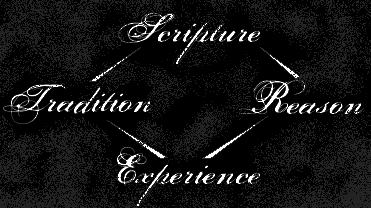
Now the Free Methodists do actually believe in tradition as a valid way of receiving truth along with Reason and Experience. Now I had to make my own picture because when I started looking for pictures of the Wesleyan Quadrilateral on the internet, mostly what I found was articles debasing the ideas that tradition was an acceptable source of truth for the believer (at which point I started looking for the non-existent comment button on their sites) Unlike Catholicism, which holds an about equal view of Scripture and Tradition, the Quadrilateral creates a hierarchy: Scripture, then Tradition and Reason, then Experience.
But all of this to say, I realize suddenly why it is hard for people to embrace and love church history in the way that I have come to love it- as a text for understanding who God is, what the Church is supposed to be like and how I fit into all of that. And without seeking that tradition, all we are left with is our own thoughts about God instead of the fullness of the history of Him interacting with his people.
I have come to love the words and lives of the saints, the creeds, the truth of God contained in the history. And I have realized that I do hold not to Sola Scriptura, but rather to Prima Sciptura, scripture first, but certainly not the whole.

August 22, 2009

Only God Can Save Us... So What?


In Christ alone! who took on flesh

Fullness of God in helpless babe!
This gift of love and righteousness
Scorned by the ones he came to save:
Till on that cross as Jesus died,
The wrath of God was satisfied -
For every sin on Him was laid;
Here in the death of Christ I live.

A few weeks ago I wrote a blog called "Only God can save us." In it I gave the historical (and I think still relevant) defence for why Jesus was God. It was long, probably too long, but the reality is they didn't come to the conclusion that Jesus was God on a whim, but after careful searching of the Scriptures, their own reason, ministry experience, and the leading of the Holy Spirit.

However in 2500+ words I left a rather important question unanswered... So what?

So what if Jesus is God? Does it really make that big of a difference to the every day walking out of faith? And what do we mean by faith any ways? Is the belief that Jesus was God a core issue to Christianity, or can we take it or leave it.

Upfront I will say I don't know what "the list" of all the things a person has to believe to be a Christian or if even such a list exists, but I do however think there are some repercussions to beliefs held by both sides.

The starting point in all of this for me was a young man I met at Church who did not believe that Jesus was God. He was raised in the Church, knew the bible stories, and wasn't under any sort of angst toward Church or God. He had just taken the phrase "Son of God" to mean that he wasn't God just as if I had said the "Son of the President" wasn't the president. It makes good logical sense but then what was Jesus to be to us? I asked that same young man the same question. His answer? Jesus wasn't God, he was the Son of God, just as we are to be Children of God, but where we fall short he succeeded and became the ultimate example of how we should live and even die.

Now in some sense he's right. There is an aspect of practical Christianity in which Christ stands as our example for daily life through his actions and through his teaching. In fact, in some ways we often miss this aspect of His life in evangelical Christianity. He is an example. He did tell us to do things. But was that all he was?

If Jesus was just an example for us to follow, then what was his death on a cross about? Perhaps the fulfilment of Jesus' own words "do not resist an evil person" but then where does salvation come from. Not from His death but rather from our adherence to a certain set of ideals. If this is true, then how are we judged at the end of life here on earth? By our adherence to these rules and principles? By our intentions? By the amount of our improvement? And then aren't we in a sense saving ourselves? What about Ephesians 2:8-9- "For it is by grace that you have been saved through faith, and this is not your own doing, it is the gift of God, not by works, so that no one may boast."

The reality is that if Jesus wasn't God, then we are still under the law because he was only able to "fulfill" the law for himself

If Jesus wasn't God, then he couldn't have died for all our sins, because he was unable to know them.

If Jesus wasn't God, then we are left with a religion based on our works and not the work of God, and leaves our salvation in question on a minute by minute basis

If Jesus wasn't God, then as Paul says we are to be most pitied

Though I'm not sure what else is on "the list" I talked about earlier, it seems to me that the Gospel must include the idea that Jesus was God, that the Word of God, who was God, became flesh and dwelt among us. That is where grace begins, that almighty immutable, all knowing, Lord and Creator of all, took on the fullness on man, to restore us to a right communion with Him. It is his vigorous pursuit of us that has accomplished this.


July 19, 2009

High Church.


I went to a wedding that included mass yesterday.
There's times where I wish I went to "high church"
I love the rich traditions and that every thing in
the liturgy has been thought through to glorify God
and express correct doctrine, instead of being done
on the fly, or used because the song has good music to
it.

I don't plan on converting anytime soon.
I just have the ability to appreciate it.

Here's an excerpt from the Eucharist (Which means
"thanksgiving" and what the protestant church typically
calls communion)

Glory to God in the highest
and peace to his people on earth.
Lord God, heavenly King,
Almighty God and Father,
we worship you, we give you thanks,
we praise you for your glory.
Lord Jesus Christ, only Son of the Father,
Lord God, Lamb of God,
you take away the sin of the world:
have mercy on us;
You are seated at the right hand of the Father:
receive our prayer.
For you alone are the Holy One,
you alone are the Lord,
you alone are the Most High,
Jesus Christ,
with the Holy Spirit,
in the glory of God the Father. Amen.

July 7, 2009

Only God Can Save Us

"Only God can save us."

I love Church history, especially the theological development that the church has experienced in the last two thousand years. You see, I believe in revelation and that there are truths that exist that have either been forgotten or never discovered before, but have always existed. This is not just a theological idea but a world view. Though Democritus came up with the idea of the atom, and people like Bohr and Rutherford drew us a clearer picture of the atom, the atom has been around as long as there had been matter in the universe. Truth exists, and through various means and ways we learn more about it, through the application of scientific knowledge, through logical reasoning, through tradition and through indirect and direct revelation. What I'm getting at here is that truth exists and belongs to the creator of that truth, God, and is not subject to change or alteration, however what we know of that truth is being revised and changed as we learn more.

When we apply this concept to who God is we can see that throughout the text of the Bible that God is constantly revealing more about who He is and what He is like. There's a progression of sorts, with a specific purpose that constantly gets brought up again and again. God is looking for a relationship with us. When I read through the book of Genesis I constantly have to remind myself of one thing - the bible didn't exist yet! They had no revelation other than what God had told them. They knew God didn't like murder and wanted sincere offerings from the story of Cain and Abel. They knew He wanted righteousness in all of man kind and was willing to punish the unrighteous from the story of Noah. They knew that God was willing to talk to people directly and even put up with people who questioned His authority and goodness. But no Ten Commandments. No Jewish food laws. No rules about building parapets on the roof of your house. No promise of a Messiah (and really, in their minds, probably no realization of the need of a messiah) He wasn't, in their minds, even really God as we know Him; God, the one and only. He was their God, but still just a god among many.

Why is this important you might ask? Because there is a key distinction about change I am trying to point out, God does not change, but what we understand about Him does. In fact when we look at God revealing himself to humanity its lot like teaching math or a foreign language to somebody. I think, if you really wanted to. You could sit down with the whole corpus of knowledge of math books from elementary addition and number theory all the way up to calculus and you might have 4 or 5 large textbooks worth of information. And you could just sit down and read it. Straight through. Depending on your reading speed, it might take you a week or two, maybe as long as a month. So why do we spend 12-16 years studying math in school? Because the concepts and principles of mathematics must be learned, not just merely read about. The same is true about God, He waits for the people to get a concept before He moves on to the next one. In a sense He is teaching the human race what He is like, and how they should live in light of that revelation. It doesn't mean that what was revealed first is now irrelevant, rather it becomes the foundation on which the rest of the house is built. I have some beliefs about what those foundational things were and how they were revealed in Genesis but for now I just want to focus on one of those; God speaks.

I thank God all the time that He speaks. That He spoke in the past, that He's still speaking today. I do not think that Revelation 22:21 was the last thing God had to say to us. He has fleshed out the what was meant by the promise he made to Abraham, that Abraham's seed would be a blessing to the nations in the old testament. We see a new course of the fulfilment of that promise in the new testament. And through church history we see the application of that promise through the people of God. Which is why I think church history is important. It shows us how we got to where we are now and why we believe what we believe. The old testament and the Gospels are primarily a Jewish phenomenon. After Pentecost there started to be more and more gentile followers of what was called "The Way" called such because Jesus said he was the "Way to the Father and no man enters except by me." And there came a time when their process of conversion was called into question. Did they have to convert first to Judaism and all that entailed with the food laws and methods of dressing and so forth before they could become followers of the Messiah. So they got together all the big names in the Church at that time, Paul, Peter, James and others to come to some sort of decision. Their conclusion was that gentiles did not in fact have to become Jews to become Christians. And what did they base that decision on? Look at the end of Acts 15 - "It seemed good to us and to the Holy Spirit."

This is where the idea for the church councils came from. Get together the best minds and the best leaders from the church and hammer out various issues as they arose. All of this to say, that while I don't believe that their conclusions at each of these councils (there were seven that are generally accepted.) The thrust of these councils was usually theology, soteriology, and heresy though they discussed all sorts of things and were pretty rich with intrigue (my favorite story involves the gift of ostriches to the king, but we'll save it for another time)

What I want to get to in this particular case is the first of these meetings. They were looking to answer a question that Jesus asked of his disciples; "Who do you say that I am?" They started with the idea that only God can save us. In fact Jesus' own name comes from the name Joshuah which means YHWH saves. Now that presents us to with a small problem. Why? Because Jesus claims repeatedly to be the only way to salvation and eternal life.

"When the Son of Man comes in his glory, and all the angels with him, he will sit on his throne in heavenly glory. All the nations will be gathered before him, and he will separate the people one form another as a shepherd separates the sheep from the goats...Then they will go away to eternal punishment, but the righteous to eternal life." (Mathew 25:31,36)

The phrase "son of man" is one of the titles used of Jesus and the kings of Israel. Here he claims that it will be him, Jesus, who sits on the throne and will separate the wicked from the good and send the wicked to eternal punishment and the righteous to eternal life. But only God can save us.

"Just as Moses lifted up the snake in the desert, so the Son of Man must be lifted up, that everyone who believes in him may have eternal life. For God so loved the world that he gave his one and only Son, that whoever believes in him shall not perish but have eternal life. For God did not send his Son into the world to condemn the world, but to save the world through him. Whoever believes in him is not condemned, but whoever does not believe stands condemned already because he has not believed in the name of God's one and only Son." (John 3:14-17)

Everyone who believes in the SON will have life. Not the Father, not YHWH, but the son. And the world was saved through the son. But only God can save us

"... whoever drinks the water I give him will never thirst. Indeed, the water I give him will become in him a spring of water welling up to eternal life." {John 4:14}

Jesus will give the spring of eternal life?

"For just as the Father raises the dead and gives them life, even so the Son gives life to whom he is pleased to give it. Moreover, the Father judges no one, but has entrusted all judgment to the Son, that all may honor the Son just as they honor the Father. He who does not honor the Son does no honor the Father, who sent him."
"I tell you the truth, whoever hears my word and believes him who sent me has eternal life and will not be condemned; he has crossed over from death to life."
{John 5:21-24}

The Son can give out life to whom he pleases? He doesn't have to consult with the father?

For this is the will of my Father, that everyone who looks on the Son and believes in him should have eternal life, and I will raise him up on the last day (John 6:40)

Again "every one who believes in the Son"? This is blasphemy right? How could it not be? There are more verses just like these where Jesus claims to the "the gate", "the way", "one with the Father", "the light of the world" or my favorite...


Jesus said to her, “I am the resurrection and the life. Whoever believes in me, though he die, yet shall he live,“and everyone who lives and believes in me shall never die. Do you believe this?”

And its not like the people around Jesus didn't know what he was talking about. He said "Hey! I can forgive your sins, give you abundant life here on earth, and eternal life in the life to come! As long as you believe in me!" Well the scribes and the Pharisees under stood it alright. They grumbled the first time they heard it, argued with him about it and finally plotted his death.

When the 1st Church Council got underway they read these verses and others from the old and new testament and they wanted to know, was Jesus God or was he just very nearly God, higher and better than us, but not quite God? There aretwo Greek words they were arguing about.
Was Jesus "Homoousios", of the same substance, or "Homoiousios", of a similar substance (this is where we get the phrase "Don't change one iota", iota being the Greek letter "i"). They argued back and forth over the titles that Jesus and others called him, over his deeds in life, his death and Resurrection. But finally they found a starting point.

Only God can save us.

And yet Jesus claimed to save us. If he claimed to save us but was "Homoiousios", of a similar nature to God, then he was really "heteroousios" of a different nature than God. And if he's of a different nature, than he couldn't save us in the way that he claimed. And if that was untrue, what else did he say that was untrue? If he couldn't save us, what kind of man would that make him? At least tyrants and murderers only take the body. Here would be a man who takes the soul and the spirit. A cult leader or a sociopath at best, at worst a demon in some human form. If he was not of the same nature of God, then we should scrap the New Testament and take up the old ways of following the law, the sacrifices, and the rituals of seeking YHWH.

But then how do you explain the working of God in the lives of his followers? Amazing miracles, exponential growth, daily salivations. "He saved us" they said. "The evidence is there." Jesus was "Homoousios", the same nature as God, "made" from the same stuff, cut from the same cloth, in fact one with God. John 1 reflects that. "In the beginning was the word, and the word was with God, and the word was God." The Greek of the last phrase "the word was God" has both "Logos" and "Theos" as genitive nouns- God and the Word are the same. Who is the word? Look down a few verses. He was with God in the beginning, all things were made through him, in him was life and light, and he became flesh and dwelt among us (actually the Greek word is verb form of tabernacle, so more than just living among us he Tabernacled among us)

Their conclusion, that Jesus was God.

Did this cause some other issues? Yes! and they knew it. In fact they much of the next 4 counsels figuring out the answer to the original question "Who do you say that I am" They were settled on the God-ness of Jesus but that left them with other un-answered questions: what is the relationship between the Father and the Son? What about the "one God" belief of the Jews? Wait wasn't Jesus human too? How does that work? Um yeah and the Holy Spirit? Who or what is that? But they had a starting point. Jesus was God.

Otherwise we end up in the condition that Paul wrote about in 1 Cor 15, believing in a "savior" who could not even save himself

If in this life only we have hoped in Christ, we are of all people most to be pitied (1 Cor 15:19)

But there was to much evidence then to ignore, pointing to the diety of Christ, that they knew that Jesus was who he claimed to be and did the things he claimed to be. And the corpus of that knowledge has only increased, changed lives, awakenings, people who were lost and now are found. Halleluia!

I will close with the creed, accepted by the church worldwide, that they wrote together to keep thier minds strait and thier worship of God focused on the truth of who he is and is named for the city in which the first counsel took place.

The Nicene Creed

I believe in one God, the Father Almighty, Maker of heaven and earth, and of all things visible and invisible.

And in one Lord Jesus Christ, the only-begotten Son of God, begotten of the Father before all worlds; God of God, Light of Light, very God of very God; begotten, not made, being of one substance with the Father, by whom all things were made.

Who, for us men and for our salvation, came down from heaven, and was incarnate by the Holy Spirit of the virgin Mary, and was made man; and was crucified also for us under Pontius Pilate; He suffered and was buried; and the third day He rose again, according to the Scriptures; and ascended into heaven, and sits on the right hand of the Father; and He shall come again, with glory, to judge the quick and the dead; whose kingdom shall have no end.

And I believe in the Holy Ghost, the Lord and Giver of Life; who proceeds from the Father; who with the Father and the Son together is worshipped and glorified; who spoke by the prophets.

And I believe in one holy catholic and apostolic Church. I acknowledge one baptism for the remission of sins; and I look for the resurrection of the dead, and the life of the world to come. Amen.


July 1, 2009

Jesus is God, right?


Jesus is God, right?

I say this slightly in jest because for most Christians, its something we say we believe pretty readily but after an conversation I had at church with a guy, I went away wondering about the effectiveness of the message.

Here's how the conversation went down. I met this guy at church (actually one of the pastors brought him to me cause he had "deep philosophical" type questions and his normal go to guy wasn't there) He was taking a course on Islam taught by a Muslim and was wondering about the "First Miracle" of Jesus. Now most people have heard some allegorical teaching on the miracles of Jesus out of the book of John at some point in their lives, and when they do this they often say that Jesus changing water into wine is his "First Miracle". Now while I'm not sure that description is correct, the professor of this particular class was claiming Jesus' first miracle was that he spoke to the wise men that came to see him at his birth. (This is what the Qur'an claims Qur'an 3:46)

Now his original question had to do with how old Jesus was when the wise men came and weather or not his speaking to them would be a miracle (It wouldn't be a miracle if Jesus was say 4 or 5 but it would be if he was 1 or 2) But I was more concerned with the actual content of Jesus' supposed words from the Qur'an (though in my quick search I could not find as a quotation from Jesus; it was only stated about Jesus). His supposed statement to the wise men was "I am the messenger whom Allah has sent."

Now when I was talking to him, I took objection to that phrase. Jesus of the bible never claims to be a "messenger", John does as do the angels when they appear (which is actually the word used to describe angel - angelos in Greek just means messenger) But Jesus claims to be the Son of God, and to be of the same nature of God, and in some way actually God Himself (John 14:7-10, John 10:30, John 14:11, John, 10:37-38, John 17:11- I know these are all from John, John just has the clearest statements about the deity of Christ without needing a whole lot of explanation)

Now had Jesus appeared to the Romans or Buddhists or African Animists, there would have been much less opposition to his claim of being God. They had a plethora of gods, and one more wasn't going to make that much of an uproar. But the Jews had been uniquely prepared by divine revelation to believe only in ONE God. "Hear oh Israel, the Lord our God, the Lord is ONE!" So for Jesus to show up and claim he was God... well lets just say there were those who did not receive him as such. So this was an issue that the early Church had to deal with, answering the question that Jesus posed even to his own disciples; "Who do you say that I am?" And they didn't work it all out at once but over many years, through meeting together as a whole much like the apostles did in Acts 15, through prayer, through scripture and through the inspiration of the Holy Spirit.

So when all the church leaders got together to discuss the answer to the question "Who do you say that I am" they came up with a simple logical argument. "Jesus saved us. Only God can save. Therefore Jesus must have been God." Later councils also confirmed the humanity of Jesus, but without him actually being God, our "salvation" is a moot point and we should all revert back to the Jewish practices of sin management on a national scale.

But this man visibly flinched every time I said Jesus was God. After noticing it the first time I said it, I slipped in a comment about his deity a couple of times to seek if it was a fluke or not, but he had a visible bodily reaction every time. Now here was a guy who seemed moderately educated in the faith and enthusiastic about defending that faith in this class on Islam that he was taking and yet, it finally came out in conversation that he didn't think Jesus was actually God, but that he was just an example for us, and the "Son of God" was more of a title given to him for his righteousness.

Where did we fail this guy? It was obvious he was caught up in some sort of works based theology after talking to him, I think because if Jesus was just an example, then Christianity then becomes about trying (and failing) to live up to that standard, and there's no room for grace. There's no freedom for him, just a different sort of bondage.

Do we focus on the wrong sorts of things in our teaching and our discipleship, telling people to be like Christ and live a Christian life without giving them the understanding of who God is and how that is accomplished though Him in the various roles of the Father, Son, and Holy Spirit?

There's three questions I always try to fall back on in writing, teaching or studying the word

-Who is God and what is He like?
-What is the Church and what is her purpose? and
-How do we fit into and have relationship with God and His Church?

And I think these are in order of importance (at least for me) that without right knowledge of who he is, the church and our relationship to God and the Church will always be skewed. Classical orthodox christian teaching, especially that which comes from the annals of church history have always seemed important to me and I'm seeing more and more the need to impart that love of the discovery of who God is more and more. People need solid food to grow into mature Christians who know who God is and reflexively know the truth from a lie.

(1025, Dang way over, sorry)

January 16, 2009

Breakthrough and Impass


I feel like I have made a breakthrough in my boys bible class- they are actually starting to think for themselves. After spending a few weeks discussing prayer, i.e. what our prayers should consist of, things to pray for, prayers from the bible, and things like that my eighth grade boys have started asking the right sorts of questions- no longer is it, "How should I pray so I can get the things I want?" but "How do I know what God wants me to do?" and "Why cant I hear Him speak to me?"

We discussed the discipline of fasting yesterday. Not fasting for fasting's sake or for others to perceive you as holy, but fasting to put down the things of the world, and spend that time seeking God. As a friend of mine puts it "Word up and world down" like God and the world were two competing radios. Which one can you hear? The one that you make the loudest in your life.

I challenged them to a media fast, that is, turning off the video games, the cell phones, the TVs and Myspace to really seek after God. There were some guffaws at first, then the acceptance that they could do that for a day. To which I said how bout a week or a month? Do you really want to hear what God wants to say? Their response made my heart sad, knowing they had missed some crucial element in their education.

"Isn't there a shortcut?"

Life isn't like Candyland. There's no shortcut over the rainbow bridge.

The work of Christianity always seemed worth the effort too me. I'm being loose with my language because of my frustration, but isn't doing the work that God calls us too, infinitely more valuable than beating level seven on guitar hero?

Please give me your thoughts and suggestions? I feel that part of their openness is due to the modeling of Christ in my life, they see it and want it, but when I give them just a taste of what needs to change in their own lives to follow hard after him, they recoil as if I had dropped a snake on their desk.

How do I convince them He's more than worth it?

March 3, 2008

Man Camp


So following in the footsteps of the last few posts and the hope that the thought of a the week doesnt become a reality ("Awarness without change is worse than ignorance") I have been dealing with these issues of brokeness in my life.

In the last blog I addressed some issues with competance that I am working through. Most of them come from past experiences and while I still need to deal with my own hurts and injuries, this weekend these issues bubbled to the surface.

I went to man camp this weekend. Okay every body who didnt ride up in our car called it Men's Retreat, but by the end of the weekend we got a few others to call it that too. But unbeknownst to me, my step-dad also came up for the weekend. Okay well, Im 26 almost 27, I havent lived at home in 6 years, Im married and really, I have almost nothing of a relationship with him other than saying hi and seeing him at family events.

I came up with some younger guys and saw some guys there from other churches that I'm friends with so I didn't see him much. But then came along some "church" time where we got together as churches to talk about what we were learning/ dealing with over the weekend. He made some comments that were pretty mean, which I tried to ignore, but they really hurt. And I though, wow okay, maybe im just oversensitive right now, but 5 of the other six people took me aside in some way or another and asked if I was okay.

I think the one that was really eye opening for me was when one older guy came up and said, I couldn't figure out why he was being so mean to you till I realized you were his step son. He knew we were related but had forgotten because, as he said, he "couldn't even see any sort of relationship between us" and how if he had been up at camp with his son he would have been buddy-buddy running around and at least trying to do stuff together. So needless to say I was saddend. But it wasn't untill Buzzy got up and started reading "On God's Fridge" did I start crying.

God as the Dad I never had who hung up every thing I did on the fridge as a feeling of Joy and Pride over who I am and the life that I was living.

My hopes, my dreams, my heart, my passions, everything that wraps up who I am, held to the fridge with little colored magnets, excited about everything Im doing, and have yet still to do, celebrated at his kid, in all the glory of my twenty six years.

February 26, 2008

A Glimpse of Jesus

My wife and I recently started going to this 8-week marriage study at our church. Don't worry, our marraige isn't on the rocks or anything, we just would like to learn some good tools to keep us from ever getting to that point.

Anyways, I've been thinking about something that our pastor drew on a white board which I will try to recreate here.


He said from your same sex parent you get your sense of competency, from you opposite sex parent you get a sense of worth and from both of them you get your sense of belonging. We all probably have wounds in at least one of those areas if not all three. But in my particular case, I grew up with a mostly absent father, which means that to some extent I was missing out on a healthy helping of a sense of competency.

Now realize I’m not blaming my father or any thing for issues that I have. Rather I’m just opening a window on my though processes through the last couple of weeks as I've sought to root out some unhealth and to find healing for old wounds that I didn't realize were there.

My particular thought on that Tuesday night was, okay so dad wasn't around, I didn’t get this supposed dose of competency that I was supposed to get as a kid, but what are the normal compensation factors for that lack in a persons life and more specifically, in my own life.

I’m not sure what the normal ones are, but in my case, it’s a drive to be competent. At anything. It’s made me smart, cause I studied hard and read a lot of books. It made me good at a lot of weird things because I was always striving

But behind all of those outer doings, there has been an inner struggle over shame. I feel ashamed when something doesn’t work out or I can’t figure something out. There’s a feeling that if I just did “it” a little better some one might take notice of me and say something about it. Not that “it” was ever a fixed thing; just simply what ever I had happened to put my hands to that day. School was a perfect place for that. I excelled, I stood out, I got words of affirmation, and how God was going to do great things through me.

I realize that even though I'm seeing it more clearly, it has been about a two year process to get to this point, and the details aren’t important for this discussion but I ended up being in a place where as long as I was keeping up with and exceeding what I had previously done, I was praised, especially in ministry. And I found a lot of acceptance of my competence. As long as I kept up.

I think that’s maybe what hurts the most. When I stopped rushing headlong into the fray, almost every one else passed me by, gone on to take care of other things. Some of these relationships have been restored; others are coming around, and others still I have little hope for but in God’s power.

And its not like I’ve been healed from these feelings of shame. They are still there, I recognize them, some times they get me down, and I don’t always know what to do about them. I was supposed to be somebody, right? Did I, like the wayward son, squander away my inheritance? Did I miss some opportunity or do something wrong? And when I'm faced with not even being able to provide real well for my family, these feelings intensify.

In the last couple of months I have faced more rejection than I really care to think about with the job situation. Most people might get sad that they didn’t get a job or what ever. To me it feels like a personal rejection of who I am. I’ve always gotten jobs I’ve wanted. They fall in my lap. People desire me or at least my skill set to be apart of things they are doing. Maybe this is why I'm going through this, because its time to move on from this place.

I wrote last time about brokenness, God only moving when people were broken, and my wife asked me if I was broken yet, I had no answer because I wasn’t sure what I needed to be broken from.

It’s prideful self-confidence that masks itself through nonchalantness.
It leads to self-reliance and impatience to wait on the lord.
It leads to planning and scheming and trying to guess how to be ready for whatever life throws my way.

The key to brokenness as I see it is the careful application of truth to my life through the Word of God, implanted by the Spirit so that I might actually accept the Father’s love and acceptance without the feeling I must earn His respect, before He calls me son.


A Glimse of Jesus is a book I have started reading. He calls Jesus "the stranger to self-hatred" and calls us to be the same, to acknowledge our weaknesses and yet still walk in the truth of our position as sons of God.

January 11, 2008

“Lights will guide you home and ignite your bones…”

I was reading through the first couple of chapters of Exodus, where the Israelites are becoming more and more oppressed by pharaoh and the Egyptians. What were they doing? It seems they were making brinks and building cities. I’m not sure I follow Pharaoh’s reasoning in scripture, but he gets afraid at the copious numbers of Israelites in the land, that they might side with the enemies of Egypt in some future war, and decides to work them hard, get rid of the male children and put slave masters over them. So the people get oppressed and cry out to God. So God snaps his fingers and smotes the Egyptians right? Not quite. During this time a baby gets born, and through a set of unforeseen circumstances becomes Pharaoh’s daughter’s adopted child. Moses lives the Egyptian equivalent of the high life and pretty much is either ignorant to or indifferent to the plight of his people. At some point in his adult hood he gets caught killing an Egyptian who was beating an Israelite and flees the country. He marries, has children, and then God appears to Moses in a burning bush, 40 years after his escape from Egypt. After leaving Egypt, the people wandered in the wilderness for 40 more years and then Moses dies at the ripe old age of 120 just before the people cross into the Promised Land. (Just a side note, during the wilderness wanderings they had to, on average, bury eighty-two people a day- thanks Tony)

So it was early and I had to think about it but that makes Moses about 80 years old when he goes down to Egypt to set free the Israelites. And unless I missed something, the oppression that the people were crying out to God about had been going on some time before that. So for at least 80 years, but probably more, the people languished in despair.

“Then the LORD told him, "You can be sure I have seen the misery of my people in Egypt. I have heard their cries for deliverance from their harsh slave drivers. Yes, I am aware of their suffering. 8 So I have come to rescue them from the Egyptians and lead them out of Egypt into their own good and spacious land. It is a land flowing with milk and honey-the land where the Canaanites, Hittites, Amorites, Perizzites, Hivites, and Jebusites live. 9 The cries of the people of Israel have reached me, and I have seen how the Egyptians have oppressed them with heavy tasks. 10 Now go, for I am sending you to Pharaoh. You will lead my people, the Israelites, out of Egypt."” Exodus 3:7-10

I imagine my self in the same situation. I’ve forgotten about my people, their needs their struggles or at least ignored them long enough for it them to become nothing more than a passing thought. I have a wife, I am on good terms with the in-laws, and even have some kids and sheep and land. I’m comfortable. Then God comes along and says, “I have heard their cries for deliverance”. What? Now you’ve heard their cries? Now, when I’m comfortable? I’m eighty, I’m supposed to be traveling around in an RV and collecting souvenirs from around the Sinai. Seriously God, go pick on someone else.

I’ve always heard the story of Moses conversation with God taught as, Moses was reluctant because he really wasn’t skilled or he was shy or humble. I think he was lazy. God please, please, please send any one else. And then he gave all these excuses why someone else should do it. Finally God gets mad and sends Aaron the Levite (wait how does Moses know who his Levite brother is)

But why does God wait eighty-plus years to bring his people out of captivity…
This is the question I kept coming back to in my head.

But first skip ahead a little bit. (Past the part about God going to kill Moses cause his son wasn’t circumcised, weird stuff but I have a thought about it for my next post)

Moses talks to pharaoh and pharaoh decides to make it harder on the Israelites not easier- didn’t we all see that one coming. And does Moses get thanked for trying to help them. Yeah right, they get their ropes in a knot. Then Moses cries out to God and God says that he is still going to help them (This is a short paraphrase of a chapter of Dialog)
Then Moses goes to the people and again tells them what God said

Chapter 6, Verse 9
Moses spoke thus to the people of Israel, but they did not listen to Moses, because of their broken spirit and harsh slavery.

And when I think back to question about why does God wait so long, it seems like at this point he has waited too long. The people have been broken by their slavery. Not just in bondage. Bondage implies oppression, and oppression often brings hope for the future, hope for release and hope for change. But the Israelites were broken.

I have all these biblical themes running through my head
Stories of Exile and Oppression by Babylon, Greece, and Rome
The waiting and the longing for a deliverer in times of trouble
The hope of a coming Messiah to establish Israel for good

And I even think, yes that gives me hope, God is going to come through; he’s done it before and he’ll do it again. And so I hold on to that last scrap of hope. But I think even that misses the mark.

I think God waits till people are broken to fix them.

It seems wrong, like God is almost a bad guy, and I guess I will have to untangle all my thoughts about it over the next couple of days, but I couldn’t escape my own thoughts.

God waits till people are broken to fix them.

God waits till I am broken to fix me.

October 3, 2007

Page 1

I've got this idea from a strange book that I once read. In the book a higher echelon demon was sending letters to a lower demon who was trying to convert and circumvent a young christian who had his normal virtues and vices. While this book has a rather spurious plot line the basic point of the story was about all the things that we fail to recognize as sin or detrimental to our christian faith. One point that Jack Lewis makes in his book is in relation to church life. Keep in mind that these are demons talking, so the language takes a little thinking about.

“One of our great allies at present is the Church itself. Do not misunderstand me. I do not mean the Church as we see her spread out through all time and space and rooted in eternity, terrible as an army with banners. That, I confess is a spectral which makes our boldest tempters uneasy. But fortunately that is quite invisible to these humans.”

The very words burn in my heart and head. And I think, Great? Terrible? Spread through time and space? And I, much like that younger demon's subject have trouble seeing the Church thus and instead focus on the shortcomings of the people who make up the Church, misguided and blinded by the actions of others.

I have been thinking as of late about the narrative continuum that is the story of the Church “spread out through time and space”. It started with the revelation of God to those whom he would call His people. These stories were recorded in the Old testament, stories of God’s interaction with man. These stories teach us about the character and nature whose name was recorded as four letters. These letters with the addition of some vowels have given us God’s name as Jehovah or Yahweh. God spoke with the prophets giving them a way to live so that the people might join into life with Him. In and of them selves they were unable to stay the course that the prophets spoke of, though they also spoke of a future hope for the people that one day they would be free.

Then one day a man appeared who claimed he was God, that he had come to fulfill the hope that had been spoken for. “The The Spirit of the Lord is upon me, because he has anointed me to proclaim good news to the poor. He has sent me to proclaim liberty to the captives and recovering of sight to the blind, to set at liberty those who are oppressed,
to proclaim the year of the Lord's favor.” He was killed as a heretic, but was soon proven to be who he said he was when he was seen walking around after his very public death. Soon after a change was seen in his followers, allowing them to perform miracles and, as the prophets of the old testament prophesied, to join in life with God. Over the next two thousand years, these followers continued to seek God, learning more about Him and how to be in life with him.

Which leads us to today. We often seek God, but we insist on asking questions like what should I do about my job? Should I marry this girl or that guy? How can I get out of debt? Why is there evil in the world? Should I be a Calvinist? What church should I go to? While these are all good questions, I think a better one, a question that is more in line with the heart of God is this, what is to be our role in the history of the Church?

But to speak of the history of the church one must assume a role much more grand than that of an average American christian. Much in the same way that Christ turned fishermen and tax collectors into missionaries and Evangelists. Somehow we have taken the term Christian and associated it with “good people” who pay their taxes (give to Cesar what is Cesar’s) don’t speed (obey the laws of the land) don’t cheat on their wives (don’t commit adultery) don’t cuss (let no unwholesome word come from your mouth) don’t drink or smoke (your body is a temple). But God calls us to do good not just be good. For those same people who follow all these supposed rules of the church, walk by homeless people on the street, drive by those broken down on the road, we lock our doors to keep out the hungry, and we close our hospitals to those who are dieing. Friends, the heart of God is for widows and orphans, the poor, the blind, the sick. His heart is for healing our lands. There's this story in Mathew 25 that quite frankly doesn’t fit into any theology I was ever taught in church and scares the bejebers out of me

“When the Son of Man comes in his glory, and all the angels with him, then he will sit on his glorious throne. 32 Before him will be gathered all the nations, and he will separate people one from another as a shepherd separates the sheep from the goats. 33 And he will place the sheep on his right, but the goats on the left. 34 Then the King will say to those on his right, Come, you who are blessed by my Father, inherit the kingdom prepared for you from the foundation of the world. 35 For I was hungry and you gave me food, I was thirsty and you gave me drink, I was a stranger and you welcomed me, 36 I was naked and you clothed me, I was sick and you visited me, I was in prison and you came to me. 37 Then the righteous will answer him, saying, Lord, when did we see you hungry and feed you, or thirsty and give you drink? 38 And when did we see you a stranger and welcome you, or naked and clothe you? 39 And when did we see you sick or in prison and visit you? 40 And the King will answer them, Truly, I say to you, as you did it to one of the least of these my brothers, you did it to me. 41 Then he will say to those on his left, Depart from me, you cursed, into the eternal fire prepared for the devil and his angels. 42 For I was hungry and you gave me no food, I was thirsty and you gave me no drink, 43 I was a stranger and you did not welcome me, naked and you did not clothe me, sick and in prison and you did not visit me. 44 Then they also will answer, saying, Lord, when did we see you hungry or thirsty or a stranger or naked or sick or in prison, and did not minister to you? 45 Then he will answer them, saying, Truly, I say to you, as you did not do it to one of the least of these, you did not do it to me. 46 And these will go away into eternal punishment, but the righteous into eternal life.”

I have been told all my life that the salvation of God is offered freely and all I have to do is accept it, that there's nothing that I can do to earn my salvation. The problem with that statement is that it is incomplete and stems from a misunderstanding of what salvation actually is. We tend to think of ourselves as free moral entities who have the right to self determination. But some times I don’t feel very free. Oh yes I have some sort of limited movement in my life like a dog on a leash or an electron circling its atom. I have a limited range but ultimately I am tied to a path that was not set by my own actions. Salvation is what God promised was to come, the ability to leave that set path, and to become more like God, joining into His sort of life. Salvation then as I understand it is about trading one kind of life, for another. But rarely do we find this sort of salvation being proclaimed from the pulpit. Because engaging in this different sort of life is going to put us at odds with the world and those that love it.